

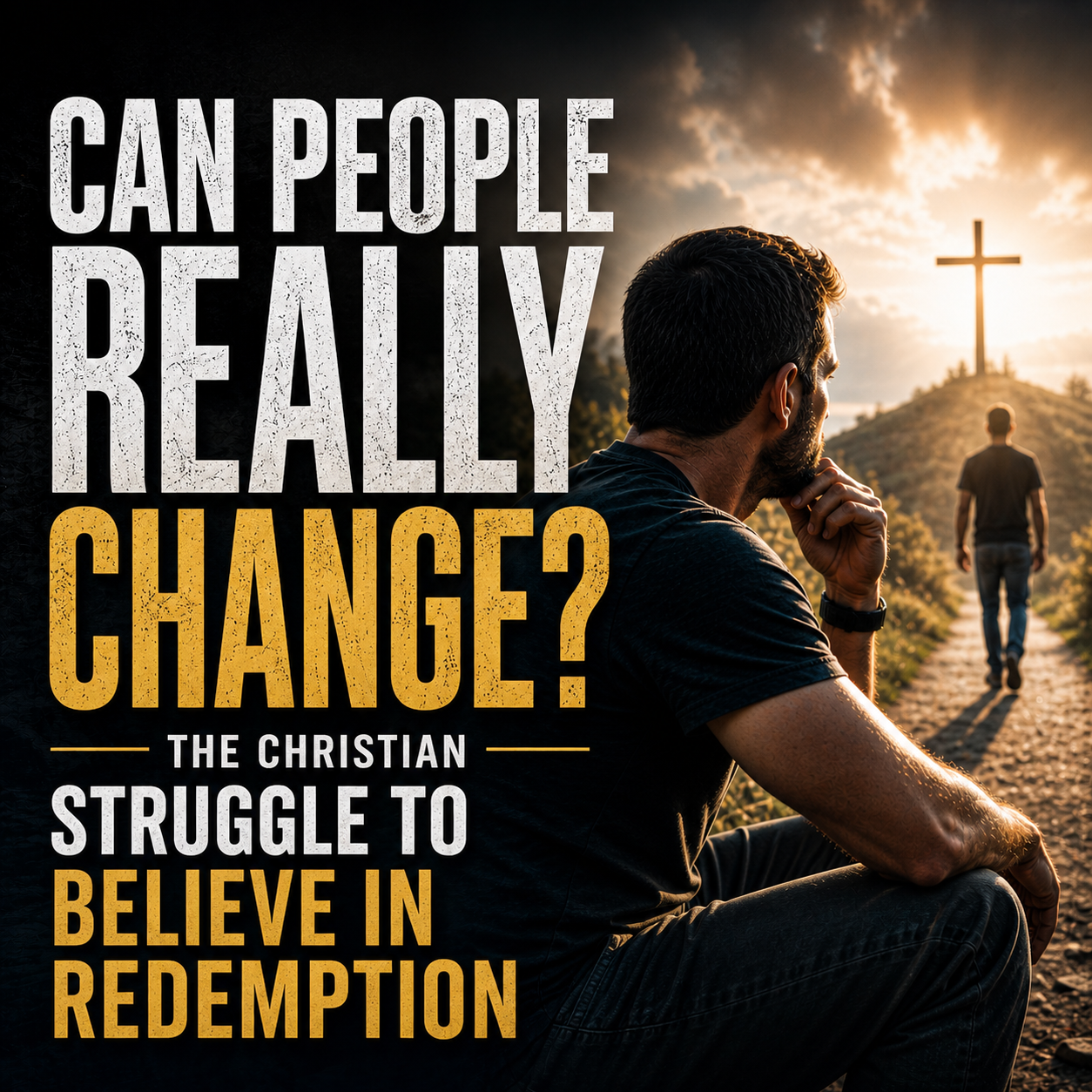
Most Christians say they believe in redemption.
We believe Christ changes people. We believe grace is powerful. We believe salvation creates a “new creation” as described in 2 Corinthians 5:17. We nod along to testimonies about transformation. We celebrate stories about addicts becoming sober, criminals becoming pastors, and broken men rebuilding their lives through Christ.
Until the person who changed is someone we remember too well.
That is where things become uncomfortable.
Most of us have someone from our past who immediately comes to mind. Maybe it was the guy from high school who slept with everyone, cheated constantly, mocked Christians, manipulated people, and left destruction everywhere he went. Maybe it was the girl who spread rumors, betrayed friendships, or built her identity around chaos and selfishness. Maybe it was someone who personally hurt you.
Then ten years later, you see them posting Bible verses, serving in church, talking about Jesus, raising a family, or leading a ministry.
And if we are honest, something inside us resists it.
Not always outwardly. We may even say the right things publicly.
“Praise God.”
“People can change.”
“What a testimony.”
But privately, another thought creeps in:
Yeah, but I remember who they really are.
That tension reveals something important about the human heart.
Christians love redemption in theory. We struggle with it in practice.
The gospel itself is built on impossible transformation. Scripture is filled with people whose pasts should have permanently defined them.
Moses was a murderer.
David committed adultery and arranged a killing.
Peter denied Christ publicly.
Paul hunted Christians before becoming one of the apostles.
The Bible does not hide their failures. In fact, it emphasizes them. The point is not that good people improved themselves. The point is that God transformed deeply flawed people through grace.
Yet many Christians quietly hold an unspoken belief that some people are disqualified from full restoration in our minds.
We may intellectually believe God forgives them while emotionally refusing to update our view of them.
That disconnect matters.
Part of the struggle is understandable. Memory is powerful.
When someone hurt us, embarrassed us, betrayed us, or represented everything we disliked, those experiences become attached to their identity in our minds. We freeze people in time.
That is especially true when we knew someone during their worst years.
High school and college versions of people often become permanent mental snapshots. We remember the drunk version. The arrogant version. The manipulative version. The reckless version.
Even after years have passed, our brain still reaches for the old file.
We see the changed man preaching about faith and immediately remember him blacked out at a party mocking Christianity.
We see the woman serving faithfully in church and remember the cruelty, gossip, or destruction she once caused.
Part of this skepticism comes from wisdom. Christians are not called to become gullible. Scripture repeatedly warns about false repentance and performative faith. Jesus Himself said we would know people by their fruit.
Real transformation should produce visible change over time.
But sometimes our skepticism is not discernment. Sometimes it is pride.
There is something strangely comforting about keeping people trapped in their old identity.
Why?
Because it protects our own sense of moral order.
If the “degenerate” can truly change, then grace becomes bigger and more disruptive than we are comfortable with. It means God’s mercy reaches people we mentally categorized as hopeless or fake or ruined.
It also forces us to confront something difficult about ourselves.
Most Christians prefer redemption stories where the distance between “us” and “them” remains obvious. We like testimonies that still preserve our feeling of being comparatively righteous.
But the gospel destroys that hierarchy.
Romans 3:23 says all have sinned and fall short of the glory of God. Not some. All.
The socially polished sinner and the publicly reckless sinner both stand in need of grace.
The respectable church kid who hides pride, lust, bitterness, or self-righteousness is not spiritually superior to the former addict or womanizer who genuinely repents.
That reality offends religious pride.
One of the most honest redemption stories in Scripture is Paul’s conversion.
Before becoming Paul the apostle, Saul persecuted Christians violently. He approved executions. He terrified believers. Then Christ radically confronted him on the road to Damascus.
Afterward, Saul immediately began preaching Christ.
And what happened?
The believers were suspicious.
Acts 9:26 says the disciples were afraid of him because they did not believe he was truly a disciple.
That detail matters.
The early Christians were not instantly trusting. They struggled to reconcile the man they knew with the man standing before them.
That feels very human.
But eventually, the evidence of transformation became undeniable. Saul’s life changed. His priorities changed. His mission changed. His fruit changed.
The church had to wrestle with a difficult question:
Do we really believe God can make someone new?
That same question still confronts us now.
Part of this conversation requires nuance.
Forgiveness does not automatically erase consequences or instantly restore trust.
If someone abused people, manipulated relationships, cheated constantly, or caused serious damage, wisdom may still require boundaries. A transformed life does not erase history overnight.
Christianity does not demand naive trust.
Repentance should produce consistency, humility, accountability, and visible fruit over time. Sometimes genuine restoration takes years to establish.
That is important to say clearly because many people have experienced counterfeit repentance. They have watched people use religious language while continuing destructive behavior underneath.
That reality makes people cautious, and sometimes rightly so.
But there is still a difference between healthy discernment and refusing to believe redemption is possible at all.
One says:
“I need time to see lasting fruit.”
The other says:
“No matter what they do, I will always see them as who they used to be.”
Those are not the same thing.
This is the part most Christians do not like admitting.
Sometimes we secretly want certain people to stay condemned in our minds.
Especially if they hurt us.
If someone wounded us deeply, their transformation can almost feel unfair. We remember the pain they caused while everyone else celebrates their redemption story.
It can feel like history is being rewritten too easily.
That emotional tension is real.
But Christianity has always required believers to wrestle with radical mercy. Jesus told Peter to forgive “seventy-seven times.” The cross itself is the ultimate picture of mercy extended toward undeserving people.
None of that minimizes pain. It simply reminds us that God’s grace often offends our natural instincts about fairness.
The older brother in the parable of the prodigal son illustrates this perfectly. While the father rejoiced over the son’s return, the older brother remained bitter. He could not emotionally accept restoration because he was still measuring worth through resentment and comparison.
Many Christians quietly live like the older brother.
If we truly believe in spiritual rebirth, then eventually our view of people must leave room for transformation.
That does not mean pretending their past never happened.
It means acknowledging that Christ may genuinely be making them into someone new.
The Christian life is built on ongoing sanctification. None of us are fully who we once were, and none of us are yet who we will become.
That applies to the former addict.
The former adulterer.
The former bully.
The former narcissist.
The former atheist.
The former hypocrite.
And it applies to us too.
Many believers desperately want others to recognize their own growth while refusing to extend the same possibility to people they dislike.
That contradiction exposes something unhealthy inside us.
Real Christian transformation is rarely flashy.
It is usually quieter and slower than social media testimonies suggest.
A redeemed man becomes dependable.
He becomes humble.
He takes responsibility.
He serves consistently.
He stops glorifying the chaos that once defined him.
He seeks accountability.
He repairs what he can.
He becomes more honest over time, not less.
Transformation does not erase personality, but it changes direction.
A man who once manipulated women may become fiercely protective of his wife and daughters.
A former addict may become deeply disciplined and compassionate.
A prideful person may become teachable and grounded.
The point is not perfection. Christians still struggle with sin. The point is evidence of a genuinely surrendered life moving in a new direction.
Jesus said a tree is known by its fruit.
Over time, fruit matters more than reputation.
At the center of this issue is a humbling truth.
Every Christian wants to be seen according to who they are becoming, not only according to who they once were.
We hope people will recognize our growth. We hope our worst moments will not permanently define us. We hope God’s grace means our failures are not the final chapter.
Yet we often deny that same hope to others.
That tension reveals how difficult true Christian forgiveness actually is.
Not surface-level politeness.
Not pretending nothing happened.
But genuinely allowing room in our hearts for God to transform people we once wrote off.
That is hard.
Sometimes painfully hard.
But the gospel leaves no category for hopeless people.
Can people really change?
Christianity says yes. Not because human willpower is endlessly strong, but because Christ is.
The deeper question is whether we are willing to believe that redemption applies to people we personally remember at their worst.
That challenge exposes our pride, our wounds, our fear, and sometimes our bitterness. It forces us to examine whether we truly believe in grace or only prefer grace when it feels comfortable.
Discernment still matters. Boundaries still matter. Trust may take time.
But Christians cannot preach rebirth while refusing to acknowledge transformation when it genuinely appears.
The gospel is offensive partly because it means people we once dismissed, hated, mocked, or feared may actually become new creations through Christ.
And if God can redeem them, then maybe His grace is far bigger than we imagined.

A Christian men's group is a committed circle of men who meet regularly for formation, accountability, and brotherhood. Isolation is quietly harming men, and honest brotherhood is one of the clearest answers. Here is what a real men's group does, what it is not, and how to find one near you.

Christian men should view Fourth of July family gatherings as opportunities for leadership, hospitality, patriotism, and legacy building. Hosting strengthens family bonds, teaches children important values, creates masculine mentorship opportunities, and reinforces faith, responsibility, and community. Small acts of leadership at home help build stronger families and a stronger nation.

A deep dive into Ms Rachel, showing you why you need to vet your children's media and what they consume.
Find a chapter nearest to you.